
Alejandro Farinas

Meta Learning
1. Introduction to Meta-Learning and Recommender Systems
Meta-Learning
-
Definition: Learning algorithms that learn from multiple learning tasks and can adapt to new tasks rapidly.
-
Objective: Improve the model’s learning capability from new data quickly using prior knowledge.
Recommender Systems
-
Definition: Systems that predict the preference or rating that a user would give to an item.
-
Types: Collaborative filtering, content-based filtering, hybrid systems.
2. Problem Statement
-
Objective: Develop a recommender system that can quickly adapt to new users or items with minimal data using meta-learning techniques.
-
Challenges: Cold start problem, scalability, and data sparsity.
3. Project Scope
-
Data Collection: Identify and collect datasets suitable for both training meta-models and evaluating the recommender system.
-
Methodology: Incorporate meta-learning into the recommendation process to address specific challenges like the cold start problem.
4. System Architecture
-
Data Processing: Handling, cleaning, and preparing data for both meta-learning and recommendation phases.
-
Meta-Learning Model Design:
-
Model architecture (e.g., neural networks)
-
Training procedure (e.g., episodic training typical in few-shot learning)
-
-
Recommender System Integration:
-
How the meta-learned knowledge is applied to new recommendation tasks.
-
Real-time adaptation to new users or items.
-
5. Implementation
-
Tools and Technologies: Python, TensorFlow or PyTorch, Scikit-learn, and possibly a database for storing user/item interactions.
-
Development Phases:
-
Prototype development
-
Integration of meta-learning with the recommender system
-
System optimization and tuning
-
6. Evaluation
-
Metrics:
-
Accuracy metrics (e.g., RMSE, MAE for rating predictions)
-
Ranking metrics (e.g., Precision@k, NDCG)
-
-
Testing:
-
Cross-validation
-
A/B testing if possible
-
7. Results and Discussion
-
Performance Analysis: Compare with traditional and state-of-the-art recommender systems.
-
Adaptability Analysis: How well the system adapts to new users or items.
8. Future Work
-
Scalability: Improvements for scaling to larger datasets.
-
Model Enhancement: Incorporating more complex meta-learning approaches or multimodal data.
9. Conclusion
-
Summarize the achievements and potential impact of the MetaREc project.

The Diagram show the training process in a meta-learning set-up.
System architecture diagram for the MetaREc Project. Ilustrates the flow from data processing to the output of personalized.

Meta Learning Workflow; shows the cyclic process of training a meta- model using episodic training and evaluating it on new tasks, with potential adjustments based on perfomance. .
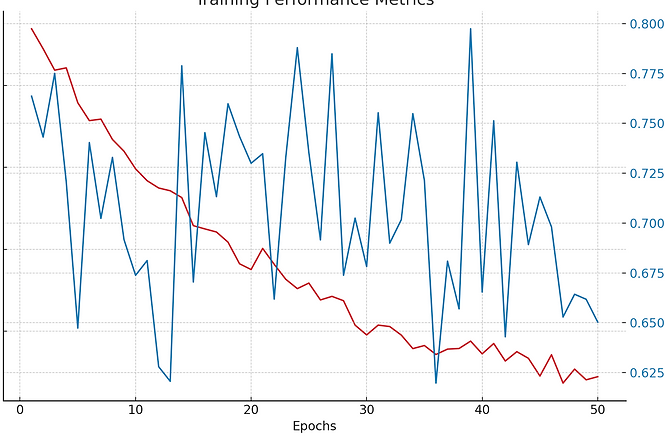
Here's a graph showing the simulated training performance metrics for the MetaREc project, featuring both loss and accuracy over 50 epochs. This visual helps illustrate the expected improvement in model performance as training progresses.